The eyes of the world were on Buffalo as it hosted the Pan-American Exposition in the summer of 1901. Over 350 acres of land between Elmwood and Delaware Avenues had been transformed into a resplendent complex of ornate buildings, pavilions, exhibits, and attractions. It was against this backdrop that events unfolded that changed the course of history.
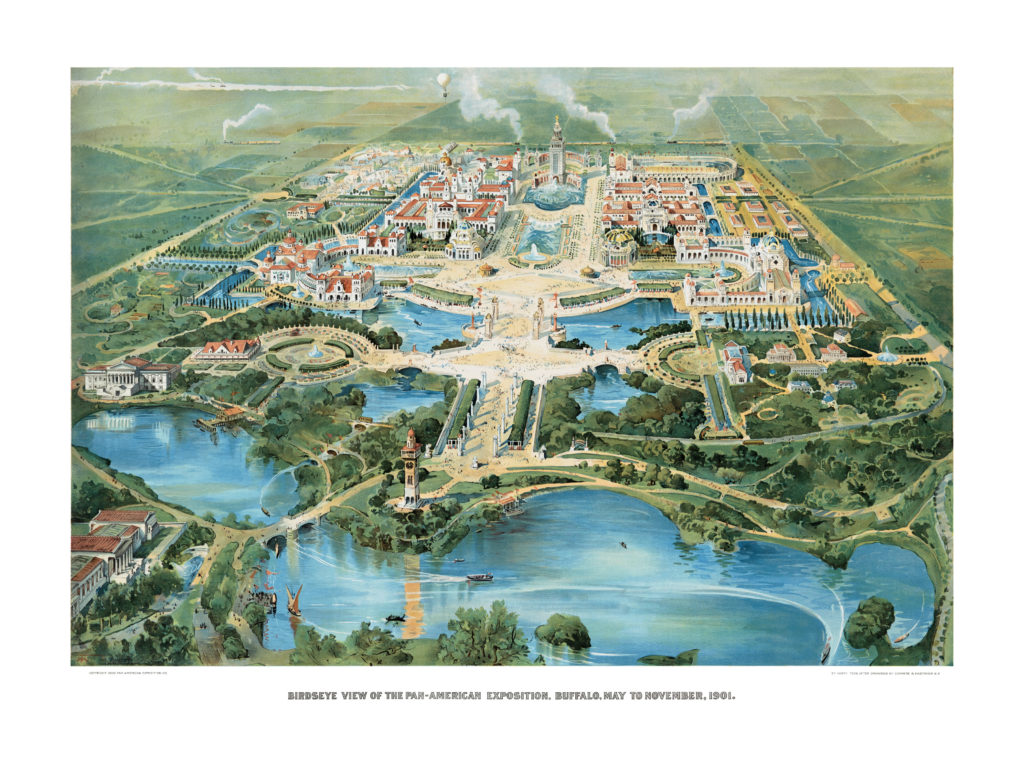
In September 1901, President William McKinley came to Buffalo to celebrate the Pan-American Exposition. He was scheduled to open the fair in May, but due to an unexpected illness, his Vice President Theodore Roosevelt was sent instead. McKinley’s visit began on September 5th, which was celebrated as President’s Day. He attended several engagements including lunch at the New York State Pavilion, which is now the home of The Buffalo History Museum.
On September 6th, McKinley began the day with a visit to Niagara Falls after which he returned to the Pan-American grounds to meet the crowds assembled in the Temple of Music. After waiting in a receiving line to meet the President, anarchist Leon Czolgosz fired two shots into President McKinley’s abdomen before being tackled by James Parker.

The President was immediately operated on, but given the serious nature of his injuries, then Vice President Theodore Roosevelt hurried to Buffalo fearing the worst. He was met by his friend and local lawyer, Ansley Wilcox, whom he had previously worked with on the creation of the Niagara Reservation. Wilcox offered his home to Roosevelt and from September 7th, the Vice President made the residence his headquarters while in Buffalo. A telegraph machine was installed in the Wilcox house for Roosevelt’s use and the house became a hub of activity.
In the subsequent days Roosevelt, made regular visits to the Milburn residence, where President McKinley was recovering. Along with the President’s Cabinet, most of whom had come to Buffalo in the aftermath of the shooting, Roosevelt monitored McKinley’s progress carefully. Initial reports were positive and suggested that the danger had passed.
On September 10th 1901, when President McKinley’s recovery seemed likely, Vice President Theodore Roosevelt left Buffalo to join his family in the Adirondacks, but left an itinerary and contact information with Wilcox should the President’s condition change. While the majority of the Cabinet remained in Buffalo, the gesture showed confidence in the President’s health.
As Roosevelt’s visit to the Adirondacks was meant to be short and recreational, he brought only the clothing he would require in the mountains. On September 13th, the Vice President was near the top of Mount Marcy when a messenger arrived carrying news of McKinley’s deteriorating health. Roosevelt hiked down the mountain to the Tahawus Club and just after midnight took off on a 40-mile stage coach ride through the Adirondacks. Normally at least a seven-hour journey in daylight, Roosevelt completed the trip in just under five hours, having changed wagons and horses three times along the route. He arrived at North Creek Station at 4:45am where he learned McKinley had passed away two hours earlier.
Roosevelt arrived in Buffalo shortly after noon on September 14th and was again met by Ansley Wilcox. Having only the clothing he brought for the mountains, Roosevelt had to borrow a suit from Wilcox and a top hat from John Scatcherd, chairman of the executive committee of the board of directors of the Pan-American Exposition.
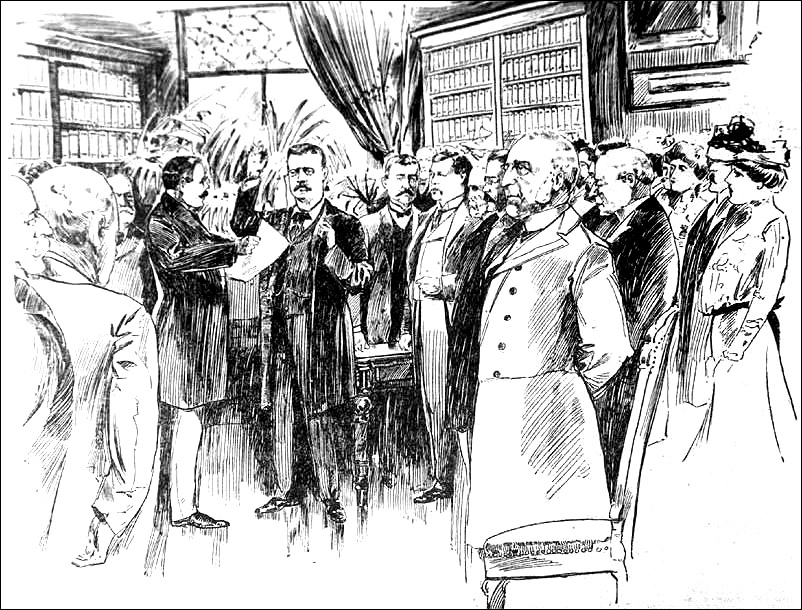
After a visit to the President’s widow, Roosevelt returned to the Wilcox home where he was met by members of the Cabinet. Just after 3:30pm approximately fifty dignitaries convened in Wilcox’s library and Judge John Hazel administered the Oath of Office in a somber ceremony. Though several journalists were present during the inauguration, no photographs were taken of the event.
From September 14th to 16th, Roosevelt remained at the Wilcox residence. He wrote his first presidential proclamation, met with members of the Cabinet, and conducted official business from the home. Roosevelt’s presidency, which began here in Buffalo, helped define the century that followed. The position he took on the issues of business, labor, conservation, and foreign policy set precedents his successors continue to follow.
The Wilcox home is one of only four locations to hold a presidential inauguration outside of the nation’s capital. To commemorate its historical significance, on September 14, 1971, the Theodore Roosevelt Inaugural National Historic Site opened as part of the National Parks Service. It continues to preserve and tell the story of the inauguration of one of the nation’s most significant presidents.

